Clay Jensen—Hannah Baker
Thirteen Reasons WhyClay Jensen—Hannah Baker is an unfinished relationship built from real attraction, limited knowledge, and opportunities neither character manages to turn into lasting closeness. Clay remembers wanting to know Hannah and caring about her, but their brief connection leaves him facing, after her death, the difference between wanting to help and actually reaching her.
Identity and Early Connection
Over the summer, Clay and Hannah work together at the movie theater. Clay later recalls that they made out at a party, yet he stresses how little he truly knew her and how much he wanted the chance to know her better. His insistence that he never took her for granted makes the relationship feel both sincere and incomplete: affection existed, but intimacy and understanding did not have time to develop.
Clay’s memory of seeing Hannah at school reveals how rumors had already shaped the distance between them. He remembers her walking past Justin Foley and his friends as they fell silent, avoided her eyes, and laughed once she had gone. Clay wanted to speak to her after Kat’s going-away party, but shyness and fear kept him from doing so. He sensed there was more to Hannah than he knew, then heard rumors about her being felt up at the rocket slide. Because she was new at school, the rumors overshadowed what he might otherwise have learned about her; he concluded that she was too experienced for him even to approach.
The Missed Chance at the Theater
The movie theater returns as the setting for Clay’s sharpest recognition of what the relationship might have become. With the last movie playing and the box office empty, he stands amid the posters and marbled floor and understands that this was his chance to reach Hannah. The thought immediately turns into an admission that he let it slip away. The place where they had worked together becomes not a beginning but the measure of an unrealized possibility.
That missed opening feeds a wider fear in Clay: he wonders whether he will ever control his life or will always be pushed around by people he trusts. His anger at Hannah’s actions coexists with longing and grief; he can resent what she did while still wishing he had reached her. The relationship therefore does not settle into a simple story of romance or blame. Its defining tension is that Clay feels both excluded from Hannah’s life and responsible for not trying harder to enter it.
Care, Distance, and Reproach
Hannah tells Clay that he does not need to watch out for her. He remembers wanting to do exactly that, but also remembers that when he tried, she pushed him away. His inward reply—imagining her asking why he did not try harder—turns the exchange into the relationship’s central unresolved argument. He can point to her rejection, but he cannot make it erase his sense that he might have persisted or offered more support.
Their closeness is also marked by an encounter in which Hannah stops Clay. In her recorded account, she recalls thinking of Justin and their first kiss, then telling Clay to stop; her hands stop pulling him toward her, and she pushes against his chest. The recollection places Clay inside a moment of distress rather than a romantic breakthrough. Hannah asks whether he could feel what she was going through, but the evidence does not establish what he understood at the time. What it does establish is a boundary: she says stop, and the physical movement between them changes.
The Tapes and What Clay Learns
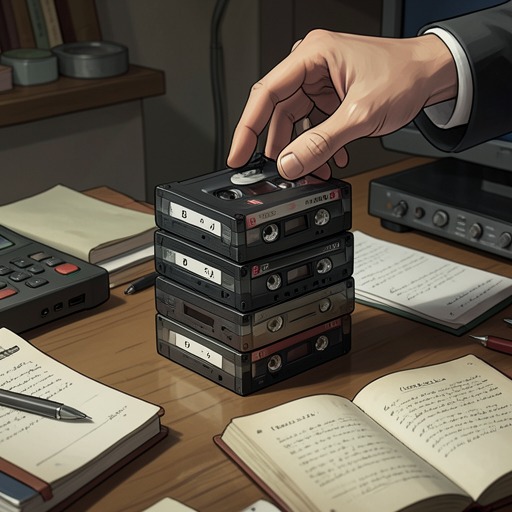
Hannah’s tapes make Clay a listener to a history he had only partly witnessed. In one account, Hannah stands and steadies herself with a hand on the bed while the shadow of Clay’s shoes remains visible under the door. He has left the room but stayed on post outside; she begins walking toward the light, uncertain what she will say when she opens the door, then stops when two more shoes appear. The scene gives physical form to their incomplete communication: Clay is near, but proximity does not mean he knows what she needs or can resolve what is happening.
Hannah’s later conversation with Mr. Porter shows the limits of the help available to her and the uncertainty with which she understands what happened. Asked whether anything occurred that might be illegal, she answers that she does not think it was rape, then is asked why she does not know. Mr. Porter offers two options: confronting the boy involved by calling him in to discuss the party, or moving on. Clay’s relationship to this disclosure is that of a listener receiving Hannah’s account after the fact; the evidence does not show him taking part in this conversation or learning its details before hearing the tapes.
An Unresolved Bond
The relationship ends without the mutual understanding Clay had wanted. He remembers a summer of working alongside Hannah, a party kiss, and repeated hesitations; the tapes add encounters in which his presence does not become the help she needs. His grief is consequently inseparable from self-questioning, but the narrative also preserves the limits of his responsibility: Hannah’s account includes her own choices and refusals, while Clay’s memories show how fear and uncertainty held him back.
The tapes turn a brief connection into a belated dialogue. Hannah speaks to Clay after she is gone, and his recollections answer her without being able to change what happened. Their bond matters not as a completed romance but as a record of the gap between caring for someone, knowing them, and successfully reaching them. It leaves Clay with affection and anger, a wish to have protected Hannah, and the painful recognition that wanting to help was not the same as doing so.